
 When a home sits on the market longer than expected, the first reaction is almost always the same: "Maybe we need to lower the price." Sometimes that's true. But after years of helping Austin homeowners sell everything from condos and starter homes to luxury properties, I've found that price is often only part of the story. More often than not, homes don't struggle because of one major problem. They struggle because of several small issues that add up. Maybe the home wasn't available to show when buyers wanted to see it. Maybe the photos didn't do it justice. Maybe the rooms felt cramped because of oversized furniture. Maybe buyers couldn't find the information they needed online to feel confident scheduling a showing. Individually, those things might not seem like a big deal. Together, they can be the difference between receiving multiple offers and watching your listing sit. Here are the biggest reasons I see homes struggle in today's Austin market. 1. You Missed Your Biggest Opportunity The first week your home is on the market is incredibly important. Your listing is brand new. Buyers who have been searching for weeks—or even months—receive instant notifications that a new home matching their criteria has become available. It's pushed to the top of search results on Zillow, Redfin, Realtor.com, and other websites. This is when your listing receives the most attention. That's why I was incredibly frustrated recently when one of my sellers wanted to block showings during the first weekend after we went live. From their perspective, it seemed like a minor inconvenience. From my perspective, it meant telling the most motivated buyers in the market they couldn't see the home during the exact moment they were most excited about it. Many buyers simply move on. Once they've found another home to pursue, they often don't circle back. If you're serious about selling, your home should be as available as possible during those first few weeks. Requiring 24-hour notice, blocking evenings or weekends, limiting showings around naps or pets, or otherwise making it difficult to see the property creates unnecessary friction. Every obstacle reduces your buyer pool. 2. Buyers Decide Whether to Visit Your Home Before They Ever Walk Through the Door Today's buyers spend hours online before they ever schedule a showing. That means your online listing isn't just marketing—it's your first showing. Unfortunately, I still see listings with only 10 photos for a 4,000-square-foot home. Our MLS allows up to 40 photos, and in most cases, you should use them. Buyers want to understand the entire property before they invest their time driving across town. Professional photography matters, but so does telling the complete story. Your listing should include high-quality photos, a compelling description, floor plans when available, surveys, seller's disclosures, utility information, warranties, and any other documentation that helps buyers make an informed decision. I've also seen listings where important documents simply aren't uploaded or where the property isn't properly syndicated to major consumer websites like Zillow, Redfin, and Realtor.com. If buyers can't easily find your home—or find the information they need once they do—they're much less likely to schedule a showing. The easier you make it for buyers to say "yes" to a showing, the more opportunities you'll create. 3. Your Home Doesn't Feel the Way You Think It Does As homeowners, we naturally become blind to things we've lived with for years. Buyers don't. I recently walked into a listing where the pet odor hit me almost immediately. The homeowner had become so accustomed to it that they didn't notice anymore. The same thing happens with clutter, worn landscaping, outdated light fixtures, dark paint colors, dirty grout, or oversized furniture that makes perfectly good rooms feel much smaller than they actually are. Presentation isn't about making your home look like a magazine. It's about helping buyers imagine themselves living there. Sometimes that means rearranging furniture. Sometimes it means deep cleaning. Sometimes it means renting a storage unit for a month to create more breathing room. Small changes often have a much bigger impact than sellers expect. 4. Buyers Want Move-In Ready More Than Ever Every buyer says they're willing to do a little work. Very few actually want to. Today's buyers have options, and many are choosing the homes that feel well cared for over the ones that come with a long to-do list. That doesn't mean you need to renovate your kitchen or spend tens of thousands of dollars before listing. It does mean fixing the things buyers immediately notice. Loose door handles. Peeling paint. Burned-out light bulbs. Broken fixtures. Stained caulk. Deferred maintenance. Small repairs that have been on your weekend project list for the past three years. One of the best investments many sellers can make is ordering a pre-listing inspection. It gives you the opportunity to fix issues on your timeline instead of negotiating them under the pressure of a contract. 5. Yes... It Might Be the Price Let's talk about pricing. Many homes that sit on the market today aren't wildly overpriced. They're just overpriced enough. I often see listings that are priced five to ten percent above where the market says they should be. That may not sound like much, but it's enough to keep buyers from ever walking through the front door. Pricing is about more than what your home is worth. It's about where buyers expect to find it during their online searches. Price slightly too high, and you eliminate a large portion of your buyer pool before they even know your home exists. If we're not seeing the activity we expected within the first two to three weeks, it's usually time to reassess. Your first price adjustment is almost always your least expensive one. Waiting months while hoping the right buyer eventually appears usually means missing your strongest marketing window. 6. Marketing Is More Than Putting Your Home in the MLS One of the biggest misconceptions I hear is that once a home is in the MLS, the marketing is done. In reality, that's just the starting point. A successful listing strategy should include professional photography, compelling copywriting, maximum exposure across Zillow, Redfin, Realtor.com, social media marketing, email campaigns, outreach to other agents, and making sure every piece of information a buyer could want is easy to find. Marketing isn't just about getting more views. It's about attracting the right buyers and giving them enough confidence to schedule a showing. If your home isn't selling, don't assume the answer is simply lowering the price. Take a step back and look at the entire picture. Is your home easy to show? Does it make a great first impression online? Does it present well in person? Have you addressed the obvious maintenance items? Are buyers getting all the information they need to feel confident? Is your pricing aligned with today's market—not last year's? The truth is that most homes don't fail because of one major mistake. They fail because of a dozen small ones. When every piece of the puzzle is working together—pricing, presentation, photography, marketing, accessibility, and strategy—you give yourself the best chance of selling quickly and for the strongest possible price. If you're thinking about selling your Austin home and you're wondering what might be holding it back, I'd be happy to give you an honest assessment. Sometimes a few thoughtful changes can make a much bigger difference than a major price reduction.
3 Comments
 If you’ve been watching the Austin real estate market, this probably feels frustrating. Homes sit longer than expected. Prices get reduced. And buyers still don’t move.
If you’re selling, it feels like the market is ignoring you. If you’re buying, it raises a red flag. And while it’s easy to assume the price still isn’t low enough, that’s not actually the main issue in Austin right now. Here’s what’s really happening. A Price Cut Doesn’t Reset the Clock The first week a home hits the market matters more than most people realize. That’s when buyers are most engaged, alerts are firing, and comparisons are being made. Once that window passes, a small price reduction doesn’t feel like a fresh opportunity — it feels like a follow-up question. Why didn’t this sell already? At that point, buyers aren’t just evaluating the price. They’re evaluating confidence. Austin Buyers Are Comparing Everything More Closely Today’s Austin buyers aren’t rushing — they’re cross-checking. They’re touring multiple homes in the same price range and asking:
When a Home Sits, Expectations Shift After about 30–45 days on the market, most Austin buyers mentally reclassify a listing. It’s no longer new. It’s available. That subtle shift changes behavior. Buyers assume:
Monthly Payments Still Drive Decisions Even when buyers like a home, the monthly payment is front and center. A $15K–$25K reduction often doesn’t change that payment enough to feel meaningful — but it does signal seller flexibility. So, buyers pause. They watch. They wait. What Actually Gets Homes Selling in Austin In today’s Austin housing market, listings that regain momentum usually do one or more of the following:
It’s not about being the cheapest option. It’s about being the easiest one to say yes to. The Bottom Line If price cuts aren’t working, it doesn’t mean buyers have disappeared. It means they’re cautious, comparative, and paying attention to signals. The homes that sell aren’t always the lowest priced — they’re the ones where the value feels clear and the strategy feels intentional. Thinking About Your Next Move? This is usually where people stop asking “What should we do?” and start asking better questions. If you’re wondering how your home fits into today’s Austin market — or whether a price change would actually move the needle — I’m happy to talk it through. No pressure. Just perspective.  If you’re considering selling your airbnb investment property, there are quite a few things you should consider. Listing your Austin area vacation rental for sale is far more complex than listing your personal home for sale, and is entirely different than listing a long term rental for sale too. You’re going to need to think about your market seasonality, existing bookings, furnishings and much more. Here are five things to consider before selling your Austin area vacation rental investment property.
1. Timing the Sale The most popular days for buyers to tour properties for sale and the most frequently occupied days for an airbnb both fall on the weekends! Naturally, this creates a bit of a predicament. If you want to sell your active short term rental you’ll want to ensure prospective buyers can actually get into the home to see it! As you can imagine, most airbnb guests would not welcome this inconvenience. Thus, you should likely block off your calendar for a few weeks following the date you list the vacation rental for sale. I can already hear your anxiety, “Block the calendar!”, she says, “We can’t do that, we will lose bookings and revenue!” Yes, you may. However, if your calendar is fully booked and you list your home for sale, you will sacrifice revenue on the sale. See, the thing is, when your home just sits on the market, buyers start to worry. They don’t consider the fact that the only time for a prospective buyer to see your home was during turnover last Tuesday. All they see is that your home has been on the market for 20+ days, and that will cost you far more than a few lost bookings. The best thing to do when considering the timing of your airbnb sale is to compare the seasonality of the sales market with the seasonality for your short term rental. March is a great time to list your Austin property for sale, BUT this is SXSW season in the short-term game and obviously not the time to block off the calendar! Identify a month where sacrificing a few stays won’t kill you, and median sales prices are historically high. 2. What Will Convey with Your Airbnb Sale When listing your Austin area vacation rental you are selling real estate, but you are also selling a whole lot more! You’re selling all the furnishings, the business, and the property itself. Do you know what all is even in the house anymore? Do you have a detailed inventory list? Do you have personal items you don’t want to convey? You need to get a full grasp on all of these things before you list the vacation home for sale. What about your short term rental listing? Do you plan to transfer this to a new owner? Can you transfer this to a new owner? Will you give a new owner all of your previously earned reviews, maid connections, contractor relationships? These are all questions you will want to ask yourself. 3. Rental History and Performance If you’re selling your vacation rental, you will most likely be advertising your property to savvy investors who will want to know what kind of ROI they can expect from your home. Thus, you have to know your numbers! Do you have a detailed profit and loss statement you can provide? If you don’t, can you make one? You need to make it as easy as possible for an investor to see the income potential in your property. Did you block the calendar for 2 months so Aunt Nancy could stay there last May? You’ll want to make note of that fact, and show what revenue you could have brought in if Aunt Nancy wasn’t such a freeloader. Did you not know about variable pricing until two months ago? Make note of that too. Show investors how with a few tweaks, your property could be a profit house! 4. Marketing Your STR Effectively While in no way is simply listing your property on the MLS an effective marketing strategy for any real estate sale, it’s particularly ineffective when you are marketing the sale of an airbnb. Your STR should be listed on the MLS, but it also needs to be marketed to those most likely to buy it- investors searching for a vacation rental investment opportunity. There are plenty of platforms out there for just that! These should be utilized, and networking with other local Austin airbnb owners and managers is also a great way to get the word out about your airbnb for sale. Effective marketing for a vacation rental home includes advertising the property, the airbnb listing, the furnishings, and the revenue! When you get the word out about all of these features to the right people in the right way, your vacation rental will sell quickly! 5. Choosing the Right Person to Sell Your Vacation Rental Given that selling a vacation rental property is drastically different from selling a regular home, you need an experienced real estate agent who understands the process for selling your Austin airbnb. A thorough, knowledgeable real estate agent in the STR space will ask you about many of the points above during your very first interaction. They will know where and how to market your vacation rental, and they will have the technical experience to make sure all the details are appropriately addressed contractually. If you’re considering selling your vacation rental in the greater Austin area, the E-Rae Realty team has the skills and experience to assist you with your sale.  Selling an investment property is quite different than selling your primary residence. When you are considering selling a property that is tenant-occupied you will need to think about how the tenants may impact the sale of the home. The lease terms and your selling timeline will dictate how you can sell the home. You could sell the home with leases in place or wait for the leases to terminate before listing the property. If you wait for the leases to terminate you will appeal to a larger buyer pool, and the selling process can be facilitated more easily. That being said, there are benefits to selling an investment property with tenants in place ( hello instant rental revenue!) If you determine that selling with tenants in place is the best option for you, following the advice below will help you sell your rental property with relative ease.
When you’re considering selling your rental property, the first step is to locate your lease or leases if you have multiple tenants. Look at when the lease term ends and the monthly rent. Does the lease terminate at a time of year that is favorable for selling for the highest dollar? Does the monthly rent match the market rate? If you’re not sure, you should contact a real estate professional to find out! If your rental revenue is below market rate, and the tenants have a considerable amount of time left on the lease it may be better to wait until closer to the lease termination date to sell. Next, you will want to look at the fine print in the lease that dictates how the property can be marketed. Identify what rights you as a landlord have to market and show the property. Some leases will allow for showings within a certain amount of days prior to the lease ending. Other leases may state that the tenant can pay a fee to waive the landlord’s right to allow showings during that time period. If you determine that listing your home for sale with tenants in place is the best strategy, you MUST adhere to the showing terms dictated by the lease. Furthermore, you will want the tenants to be cooperative in the process. Communicate your intentions to sell early on; you will want to ensure they understand that the lease terms will stay the same when the property is sold. The only difference will be the landlord is changing hands. At closing, the security deposit will be transferred to the new owner, and the new owner will deliver instructions for paying rent to the tenants. You also need to make sure to have a plan for how showings will be allowed and how much notice the tenants need prior to showings. Will you communicate showing requests by a text or phone call? Do you need to inform all tenants or is their one point person with whom you can communicate? Are there certain times or days that will never work for showings? How much notice does the tenant need to allow a showing? In addition to clearly communicating showing notice protocols, it’s also important to set expectations for how you would like the home to be presented fo showings (free of clutter, clean counters, beds made, etc). Ultimately, you can’t force the tenant to ensure your property appeals to buyers. However, you may be able to incentivize tenants with a discount on rent, a gift or you could offer a free home cleaning prior to an open house. In the end, this small expense is well worth it to ensure the home shows well and thus yields a higher sales price. Selling your rental property with tenants in place means you are selling your property to an investor! Investors have one primary goal - to purchase a property that will provide a return on investment. In order to determine how profitable the property may be, investors will want to know all the figures. Make sure that the monthly rents are marketed. If you have detailed records of expenses and improvements to the property you should provide these. If you installed a new roof last year, or your property has a 10% cap rate, these are facts the investor will want to know! Make it as easy as possible for an investor to see the financial benefits of your property. Do you have questions about selling your Austin area rental property? Give me a call, and I’ll be able to help you determine the best strategy for your unique situation. If you are considering selling your Austin area home, you are likely wondering what fees are involved in the sale. In order to determine if selling your home is in your best financial interest you need to understand all of the costs associated with selling, and have a good idea of the price at which you can sell your Austin area home. Many of the costs associated with selling your home are negotiable items in the standard Texas real estate contract; however, there are items that are typically seller expenses and other fees that you are certain to pay when you sell your Austin house. Below is a break down of the various fees you can expect when selling your home in Austin, Texas.  Real Estate Broker CommissionsIf you are going to be listing your home for sale with a real estate agent, you are going to have to pay commissions. Although there are no set commissions in Austin, the vast majority of homes listed for sale in the Austin Board of Realtors MLS will show a 3% buyer’s agent commission. Real estate broker commissions are negotiated when you sign a listing agreement with a broker. In the Austin real estate market, it’s quite typical to pay 6% of the sales price as a commission fee when you sell your home. 3% of this fee usually goes to the buyer’s broker and 3% will go to the listing broker. However, as I mentioned earlier these fees are negotiable, and many brokers such as myself will offer a discount to the commission fee when you are buying and selling a home at the same time. For example, if you are selling your Austin house and buying a new home in the Austin area, I will reduce the listing broker fee to 2%. These fees may seem like a lot to you, but they cover all of the expenses and work involved with selling your home. The listing broker will pay for all photos, videography, and marketing. In addition they will respond to all inquiries about your home, show the home, negotiate on your behalf and much more. If you’re thinking of doing this on your own, you can learn more about listing your home FSBO here. Spoiler Alert: It’s a lot more work than you think and usually ends up costing you more! Title PolicyThe title policy protects against any unknown claims of ownership to the property. The cost of the title policy is negotiable in the Texas real estate purchase contract. However, it is very common for the seller to pay the cost of the owner’s title policy in the Austin real estate market. Occasionally, in competitive multiple offer situations, you will see the buyer offer to pay the owner’s title policy. This is vary rare, and not something to count on when estimating the fees associated with selling your Austin home. The owner’s title policy cost is regulated in the state of Texas. No matter what title company you use, you will pay the same amount for the owner’s title policy. These rates are based on the sales price of your home. You can view the full rate chart here. As an example on a $400,000 home sale you can expect to pay $2,413 for the owner’s title policy in Texas. If the person purchasing your home is financing the home purchase a lender’s title policy will also be required. This is typically a buyer expense. Home WarrantyAnother negotiable item in the Texas real estate contract is the home warranty. In the contract it is referred to as a residential service contract, and the contract is worded in such a way as to presume the seller will pay up to a certain amount towards a home warranty coverage program. This is a negotiable amount, and the buyer may or may not request the seller contribute towards this expense. Home warranty fees vary but you can expect to see a buyer request a seller contribution of $400-$600 towards the buyer’s home warranty. Escrow FeesThere will also be fees charged by the title company to facilitate the transaction. These are known as escrow fees. These fees vary from one title company to the next, and are usually split between the buyer and seller. However, if you are simply looking for a rough guess as to what to expect, you can estimate $500 for the seller’s portion of the escrow fees. You may also have to pay attorney document fees, recording fees, or notary fees. These should total less than a few hundred dollars. Property TaxesProperty taxes are paid in arrears in Austin. Thus, you will need to pay your portion of the property taxes for the time you lived in the home at the closing. These will be calculated based on the number of days you occupied the home and the most recent property tax bill available. Your pro-rated share of the property taxes will appear as a debit to you (the seller) and a credit to the buyer on your final settlement statement at closing. You can look up your property taxes on the county tax appraisal district’s website by simply searching for your address; here’s a link if you live in Travis County. Find the annual tax bill amount, divide by 365 and then multiply by the number of days you expect to have lived in the home for the year. Additional FeesYou may encounter other fees when selling your Austin home. If you live in an area where there is a home owner’s association, you may need to pay for a portion or all of the HOA document and transfer fees. You may also be asked to contribute towards a buyer’s closing costs. You could need to make repairs or make monetary concessions for repairs found during the buyer’s inspection. Again, all of these items are negotiable and that’s why it’s important to have a strong real estate broker by your side to guide you through the process and negotiate on your behalf.
If you’re thinking about selling your Austin area home, contact me today. I can give you an in-depth evaluation of what your home is worth and provide a highly specific estimate of all of the fees involved in the sale of your Austin home. Don’t worry, if you’re not ready to sell I’m not going to pester you with consistent calls or e-mails either! If you want to sell your home quickly and for a decent price you need to understand how today’s home buyers shop. When you truly understand home buyer shopping habits and market trends, you can take proper actions to ensure a speedy sale. You will want to consider how your home appears to buyers both online and in person, the timing of putting your home on the market, and proper pricing.  Presentation is EverythingImagine you are swiping through tinder looking for an eligible candidate for a nice date. You see hundreds of images. Some of these are appealing, some of them are not, and then there are those people who have a photo that’s so blurry you can’t even tell what they look like or even worse, no picture at all. Those profiles are almost always going to get an immediate swipe left. You want to make sure prospective buyers swipe right on your listing! First and foremost, your home needs to put on its best dress and get a killer selfie to show the public what she’s got. For a house, this means making sure the curb appeal is killer, adding flowers, power washing the driveway, and sprucing up the front door. You also don’t want to make your home like one of those profiles where the first pic is amazing and then you start swiping through a few more images and then inevitably swipe left. You need to make sure your killer presentation continues throughout the interior of the home. Ensure that any signs of wear and tear like a dog scratched door or worn carpet is rectified prior to listing your home for sale. Make sure all the clutter is eliminated, the beds are made, the furniture is an appealing configuration, and the house is clean. Then, you are ready to call in the pros for a photo shoot that will have prospective home buyers knocking at your door in seconds. Proper presentation isn’t only physical. You also want to make sure you have some meat to your listing. A pretty profile with no details will still leave some people reluctant to swipe right. In addition to showing buyers the benefits of your home, you want to tell them what they can’t see. Explain how you have a brand new HVAC system, the home is minutes away from a beautiful park, and the schools are superb. The bottom line is that if your home doesn’t entice buyers online, most people will never even take it out on a date. Professional photos and a stellar description will get prospective buyers in your door. Timing is KeyEven if your home looks amazing! You may not get as many people in the door if you don’t list at the best time. Every neighborhood will have it’s own peak seasons, market trends, and unique nuances that determine when the best time to list your home will be. It’s important to take these into consideration, and look at the historical sales data in order to determine when you should put your home on the market. You will want to time it well on a weekly level too. Listing your home on a Thursday has proven to lead to quicker and more profitable home sales across the nation. Proper Pricing Solves AllAbove all else, proper pricing solves all. Even if you ignore my other two tips for selling your home quickly, if you price your home properly it will sell. If a home is priced way lower than everything else for sale in the neighborhood and it down’t even have a single photo online, buyers will still make their way over to the home to take a look in person. On the other hand, a home with gorgeous photos, the best marketing you’ve ever seen, and a description that moves everyone who reads it will not get any showings if the price is too high. In order to sell your home quickly and for a decent profit, you need to incorporate all three of these items. Your real estate agent will pull relevant comps, comparable properties to yours that have sold recently, in order to help you determine the best asking price for your home. After comparing your home and it’s quality, size, and benefits to that of the recently sold homes in your area, the best asking price for your home will usually be quite clear.
If you live in the greater Austin area and would like help selling your home quickly, give me a call. I’ll have buyers swiping right in no time! When a property is listed for sale in the MLS, the home can be listed under a variety of different statuses. Most commonly, you are looking at homes that are listed as active. However, sometimes you may see properties listed as active continent. An active contingent property is a property where the owners have accepted an offer on the property, but the buyers must sell another property before closing on the sale of the subject property.  In Texas, there is a promulgated contingency form that outlines the terms of this agreement. The Addendum For Sale of Other Property by Buyer form specifies when the buyers must close on the sale of their current home and what will happen if the sellers receive another offer on the home. This form stipulates that if the seller receives another offer on the property they must notify the buyers of said offer. The form also specifies a certain number of days in which the buyers must either waive their contingency or the contract will terminate automatically. If the buyer elects to waive the contingency, the buyer is stating that even if they don’t sell the current home, they will still purchase the subject property. As a seller considering accepting an offer that is contingent, you should be sure to carefully read this contingency form. The date in which the buyers must sell their current home is important to review. If you are looking for a quick close, you want to make sure this date is not too far in the future. You will also want to ask questions to see how far along they are in the selling process. Do they have their current home on the market yet? If so, have your agent review the listing to make sure they are priced aggressively, and marketing appropriately. If the home is not even on the market yet, you will want to ask more questions to determine when they plan on listing the home for sale. You also want to make sure that the number of days required to respond when notice of another offer is received is not too long. In my opinion, three days is usually adequate. If the current buyers have too much time to respond, you may lose out on the second offer. 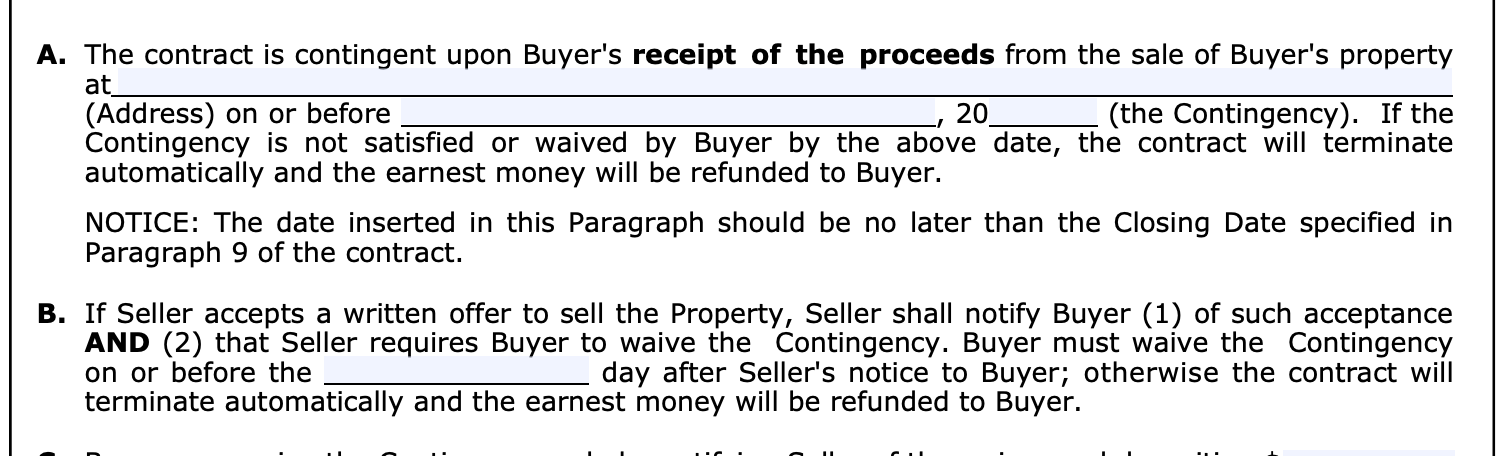 If you are a buyer submitting an active contingent offer, you should also consider how the seller will feel about the contingency. By providing proof that your current home is actively being marketed for sale and is priced correctly, you can ease the seller’s apprehensions about accepting an offer that is contingent.
One more interesting caveat in the active contingent scenario is that if you receive a second offer that is higher than the first, you can’t simply accept it. In fact, the only way you can accept the second offer is if the original buyers decide not to waive the contingency and the first contract automatically terminates. In this event, the earnest money that the contingent buyers submitted would be refunded back to them, and you could proceed to accept the second offer. If you have any other questions about active contingent status in Texas or general real estate questions, I am always here to help. Feel free to give me a call or send me an email. If you stumbled across this blog post, I’m guessing you may be curious when the best time to sell your Austin area home is. Generally speaking, homes in Austin tend to sell for more during the spring. However, this isn’t true for every neighborhood or every home. Regardless of what time of year you list your home, homes that hit the market on Thursdays tend to do better. This is why I always advocate for my seller clients to list their home on a Thursday. It may appear to be an arbitrary day; however, when you think about it, the rationale for listing on Thursday is quite strong.  Home buyers often shop for homes on the weekends. When you list on Thursday, your home is top of mind among buyers who then must coordinate with their agents to see your home. A 2018 study by real estate brokerage, Redfin, found that homes listed on Thursday sold for $3015 more on average than those listed on any other day of the week. Those homes also sold more quickly. The same study found that those listed on Thursday went under contract 6 days faster than those listed on Sunday, the worst day to list your home for sale. So, there is certainly a strong case for listing your Austin home for sale on a Thursday, but which Thursday will yield you the most money on your home sale? The seasonality of the Austin Real Estate Market strongly correlates to the public school year. Most people want to move when the kids are out of school for the year. This is why you often see the highest sales prices in May or June. In 2019, the highest median sales price for Austin Area homes occurred in May. Based on the median sales price for the Austin area, you could argue that selling your home in May vs. February would result in an extra $60,000.  Now, you must be thinking, if you live in an area where there are families, you should list your home for sale on a Thursday in May. Not so fast, the highest median sales price usually occurs in May, but that does not mean that listing your home in May will result in the highest price paid for your home. If home sales in May are the most profitable, you must list earlier. It usually takes about 30 days to go from contract to the closing, and in May of 2019 the average days on market was 48. This means, if you want to sell your Austin home for the highest price, you need to list your home in March or April in order to sell for the most money,
What about the UT area condo you purchased as an investment property and now are thinking about selling? It may not follow these same trends. Every property is different, and determining the best time to sell your unique property is not black and white. If you’re curious about when the best time to sell your Austin Area property is, contact me today. I’d be happy to provide a thorough analysis of your unique market.  Imagine this. You purchase your dream home. It has a great open floor plan, large windows that look out over the oak tree filled lawn, and a closet big enough for his shoes too. Then, six months later you suddenly get pregnant, and realize there is no way you could raise a family in what you thought was your dream house.
Well, you essentially have two options in this case. 1. You sell your current home 2. You rent out your current home There are other options, but in order to determine the best option you really need to talk a REALTOR. A real estate agent will be able to give you a realistic estimate of what you can sell your home for and what you could expect to get in monthly rent if you decide to lease the property. They will also factor in your unique lifestyle and financial situation to help you strategize the best course of actions. In an ideal world, you will be able to sell your home for more than you paid for it. A real estate agent can provide you with comparable home sales, and a net sheet showing what you would make on the sale after expenses. But, what happens if that number is negative? This is where you need to get creative. Maybe, you can lease your home for enough money each month to cover the mortgage and any additional costs such as repairs, HOA fees, etc. But, what happens if you can't? This is when you have to put your thinking cap on and start really looking outside the box. I love problem-solving and a few creative solutions could get you pinning insta-worthy nurseries in no time. If you can't sell your home for enough money as is, maybe you could make some improvements that would yield incredible returns. Invest a few grand in flooring and paint, and sell your home for $30k more! It's possible if you have an experienced professional by your side who can advise you on the best home improvement projects. Maybe, you can't rent your home long-term for a profit, but have you considered renting it short term? Airbnbs can provide way more rental revenue than a long-term tenant. You will have to look carefully at your HOA guidelines and city laws to ensure this is a viable solution. Many HOA’s limit short term rentals to leases of 30 days or more. This would eliminate the airbnb solution, but you could still rent your home furnished. I once had a client who was a traveling nurse, she told me about how traveling nurses often need a furnished rental for a few months, and they pay inflated rates for these brief leases. Furthermore, I know first hand how a monthly rental can bridge the gap between homes. When we moved into our home, we had to find a place to stay for two months before our home was ready. We paid a premium for this brevity, and many families find themselves in similar situations when they are moving. No matter what your unique situation is, I’m positive there is a solution that will allow you to move forward! Contact me today, so that we can start working on the solution that will be the easiest for you and leave the most money in your pocket!  A few months ago, I spoke with a couple who were referred to me by a previous client. They were interested in selling their new home and buying a new one. They mentioned that they were considering selling their home with Opendoor. I’m not going to lie, my first instinct was to tell them to run in the other direction.
iBuyers such as Opendoor are causing quite a stir in the real estate industry today, and they are directly competing with agents such as myself. They prey on eager home sellers who value convenience, offering a smooth and simple sale with a hefty price tag. They offer almost instantaneous cash offers and charge a higher fee to allow sellers the convenience of selling their home without having to do any work. You don’t need to de-clutter or clean or stage, and you don’t have to allow buyers to come see your home either. All you have to do is inform the iBuyer about your property’s condition, and then a representative comes to verify what you reported is accurate. Much to my surprise, about a week after I was cursing iBuyers in my head, I found myself advising my clients to accept the offer from Opendoor. I did not come to this conclusion quickly. I was turning down a potential commission. First, I reviewed the comparable homes in my client’s neighborhood. I looked at the recent sales, and I crunched the numbers. Then, I went and looked at the available homes currently listed for sale in their neighborhood. I noticed that there were homes that were sitting on the market, and had not sold yet – homes that frankly were in better shape than my client’s home, and they were asking for less money. After reviewing all of the data, I came to the conclusion that a fair asking price for my client’s home would be around $210,000. But, in order to get this, they would need to do a few things. The carpet was in rough shape and needed to be replaced. They needed to do some paint touch up; the back fence was in need of repair, and a deep clean and staging would be critical for my clients to get top dollar. Assuming my clients were able to sell their home for $210,000, and I dropped the listing agent commission to 2%, my clients would be getting approximately $199,500 for their home. (I’m leaving out other costs such as the title commitment and loan payoff amounts for the simplicity of this post.) Additionally, they would have to put about $2,000 into repairs to get the home show ready – so they’re now at about $197,500. Opendoor offered my clients $216,600 cash with a $17,328 open door transaction fee. Selling to Opendoor would essentially yield $199,272 to my clients - almost two grand more than I projected they would make selling their home traditionally. But, it wasn’t just the bottom line that accounted for my recommendation for my clients to sell to Opendoor. With Opendoor, they pretty much had a sure thing. There would be no question of if the right buyer would make an offer on their home, there would be no work preparing the home for sale, and there would be no unknown repair costs that came up after the inspection. There was no potential for a loan to fall through at the last minute, and there was no need to rearrange their lives to accommodate showings. In the end, selling to Opendoor was absolutely the right choice for these clients. However, I did remain skeptical through the process, and made sure to advise my clients on potential pitfalls. With Opendoor, you are dealing with a lot of different people. You don’t have one main point of contact, and you don’t have anyone dedicated to representing your best interests. You need to pay attention to the contract, and understand the implications. There are deadlines, and fine print that if you don’t pay attention to may have significant repercussions. Overall, it worked out great for my clients. They were selling this home to buy a new one, and having a “sure thing” deal on the sale side made facilitating the often challenging double closing much easier. Opendoor gave my clients what they refer to as a “late checkout” and what is commonly referred to in the industry as a lease back. This allowed my clients to stay in their home after the closing, and gave them extra time for the proceeds from the sale to be delivered to their bank account, and then used to purchase their new home. They also had a week with both homes so they could gradually move. They never had to clean up, or take the dogs out so that a buyer could see their home. They didn’t have to change their lives in any way. In the end, they moved into a beautiful new home, and Opendoor is still trying to sell their old home. They fixed the fence, replaced the carpet, and currently have it listed for sale for $210,000. Will ibuyers change the real estate industry as we know it? It’s hard to say, but I can certainly tell you they are losing their shirt in this deal. |